College of Education Special Populations and the Texas Institute for Measurement, Evaluation, and Statistics
Campus Administrators
Welcome, administrators, to a dedicated space to empower you with the tools and knowledge necessary to drive positive change in your schools. This page offers a curated collection of resources that harness the power of Improvement Science (IS) and the Concerns-Based Adoption Model (CBAM) framework. By leveraging these proven methodologies, you can effectively identify areas for growth, implement targeted interventions, and foster a culture of continuous improvement within your educational institution. Whether you’re seeking to enhance student outcomes, support teacher development, or streamline organizational processes, the resources provided here will equip you with the strategies and insights needed to lead your school toward success.
Improvement Science
Initiatives to improve instruction come and go in education at a frightening pace. Often teachers just wait on the sidelines as “this too shall pass” because they have seen initiatives change frequently over time. What if there were a different way to effectuate change that actually produces desired results…there is. Learn more about Improvement Science.
CBAM
The Concerns-Based Adoption Model (CBAM) has three components that help schools implement innovations. The Stages of Concern survey helps leaders assess and respond to teacher concerns about innovations. The Level of Use survey measures the extent to which staff implement an innovation. Innovation Configuration (IC) maps are well-defined guides that aid in the implementation of new practices.
How-To Guides
Often leaders have questions on how to implement one of the many aspects of Improvement Science. To assist with this, we have developed a series of 12 brief, informative How To Infographics of sometimes difficult or problematic aspects of Improvement Science in schools.
Reading Cupcake
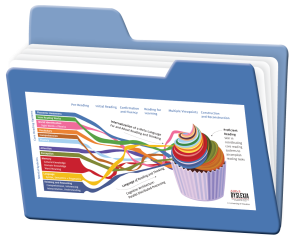
What are the skills that a student needs to successfully learn to read? How best should we teach these skills so that they work together so that children become lifelong readers? The Reading Cupcake is an adaptation of the Reading Rope and the Stages of Reading. Learn about the skills and processes that “swirl together” to lead to proficient reading and understanding of text.
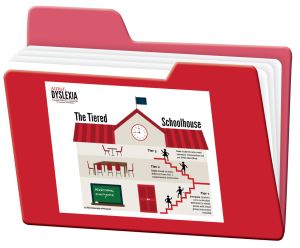
The Tiered Schoolhouse
The Tiered Schoolhouse is all about the Multi-Tiered System of Supports (MTSS). This system assists students by providing children with the level of instruction they require to understand grade level content. These levels are called tiers. Tier 1 is for every student—struggling or not; Tier 2 provides small group remediation for struggling students; Tier 3 is more intense intervention. Placement in Tier 2 and 3 is flexible; with students moving in and out as needed.
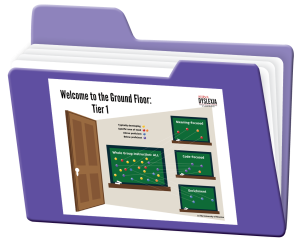
Tier 1 Ground Floor
Tier 1 is the foundation of quality instruction for all students. It is the daily instruction that students receive in their classrooms. Strengthening Tier 1 instruction benefits all students, lessens the need for placement in Tier 2 and Tier 3. Learn more about what effective Tier1 instruction looks like.
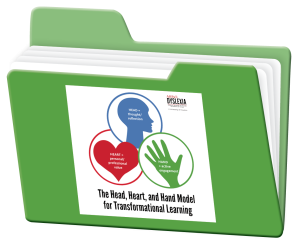
Head Heart Hand
Teaching has three main components: the HEAD, which involves thought and reflection; the HEART, which deals with our professional and personal values; and the HAND, which is our active engagement with our students. Helping your faculty to reflect upon their teaching in this way gives them powerful insights into how to help their students succeed.
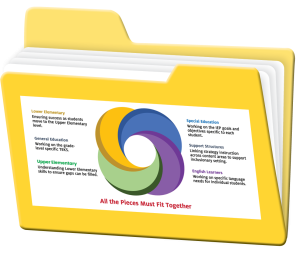
It Takes A Village
This folder is all about collaboration—building a campus culture that encourages all teachers to work together so every student learns. Rather than identifying as a primary, upper grade, special ed, EL, special or ancillary…we are all TEACHERS of children.
Every Teacher is a Reading Teacher
Create a “Every Teacher is a Reading Teacher” mindset among your educators. Learning doesn’t occur in isolated silos—reading only there and science elsewhere. Reading skills apply across the entire curriculum. Help your teachers see how they can support each other and themselves by working collaboratively across content areas.
Data Detective
Teachers have incredible amounts of student data at their fingertips. Help your staff get the most out of this data. Like good detectives, teachers need to know how to pinpoint the specific skills with which students struggle and plan for instruction that ensures student success. This short 5-minute video discusses the connection between data, instruction, and outcomes.
Make It Stick
Kids learn best when they understand how reading skills fit together and mutually support their learning. Reading skills should not be taught in isolation. Rather, teach students, for example, how phonological awareness supports phonics, which in turn, supports spelling and fluency. All the foundation skills of reading are inter-related.
Core Content
Core Content clarifies how reading skills link to other subjects across the curriculum. This 6-minute video explains how literacy links to other content areas and how content teachers and literacy teachers can support each other by teaching collaboratively.
Phonological Awareness
A student’s knowledge of Phonological Awareness (PA) highly correlates with reading success. Learn about the continuum of critical phonological awareness skills that contribute to that success as well as related decoding skills that can be introduced at the same time as upper-level PA skills.
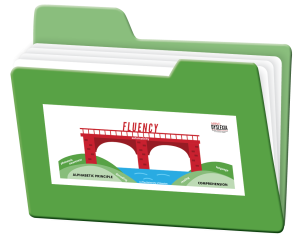
Fluency Bridge
The “Fluency Bridge” graphically represents the key components necessary for reading fluency and comprehension. The bridge symbolizes the connection between foundational reading skills (PA, Phonics) and advanced comprehension. This 10-minute video walks through the importance of each of these elements in supporting students’ reading development.
Networked Improvement Community (NIC)
A Networked Improvement Community (NIC) is the central group that will drive improvement science on a school campus or in a district.
The WWC: A trusted source of scientific evidence on education for over a decade.
The National Association of Elementary School Principals (NAESP), founded in 1921, is a professional organization serving elementary and middle school principals and other education leaders throughout the U.S., Canada, and overseas.
The National Association of Secondary School Principals (NASSP) is the leading professional organization for middle level and high school principals, assistant principals, and other school leaders across the United States and beyond.
The Council of Chief State School Officers (CCSSO) is a nonpartisan, nationwide, nonprofit organization of public officials who head departments of elementary and secondary education in the states.